Showing posts with label Kimono. Show all posts

Thursday, June 11, 2026

Haori

I had this bolt of fabric in my draw for a number of years now - I thought three, but flicking back through the blog tells me I got it in April of 2022. It came from my friend David along with a cotton yukata bolt, and three wool kimono bolts (here, here and here). This one was a shorter length - not the 12 metres needed for a full garment, but probably half that - maybe six metres or so? It was perfect for a haori, which is a jacket worn with a kimono


Not only had I never made a haori before, but the fabric itself was intimidating because it was dyed with shibori techniques that left it with a texture. Obviously that's hard to explain here when you are unable to touch the fabric, but imagine it's bumpy, not smooth. Also, my friend David had given me a piece of silk for the lining that wasn't quite enough, so I needed to really think through how to make it work. 

And all the instructions I could find on the internet for a haori were for either an unlined one, or a men's style, which is actually different because the ladies version has extra spacers to allow for the larger obi that would fit underneath. 


All the problems! Should I be the one to provide instructions for the internet on how to do this? Clearly there is a gap there....

Focusing up though, I'm really trying to sew from my stash and use what I have. We were coming into winter and I figured it was now or never for this. I studied some of my exisiting haori, did a lot of thinking, over thinking and mental gymnastics figuring out how it would work and what sewing order to do and then I got to work. 


I ended up using a lighter pink cotton to line the sleeves, but everything else was with the fabrics I had. I sewed it on Sally, except for the final collar hand sewing. I think it took a week? 


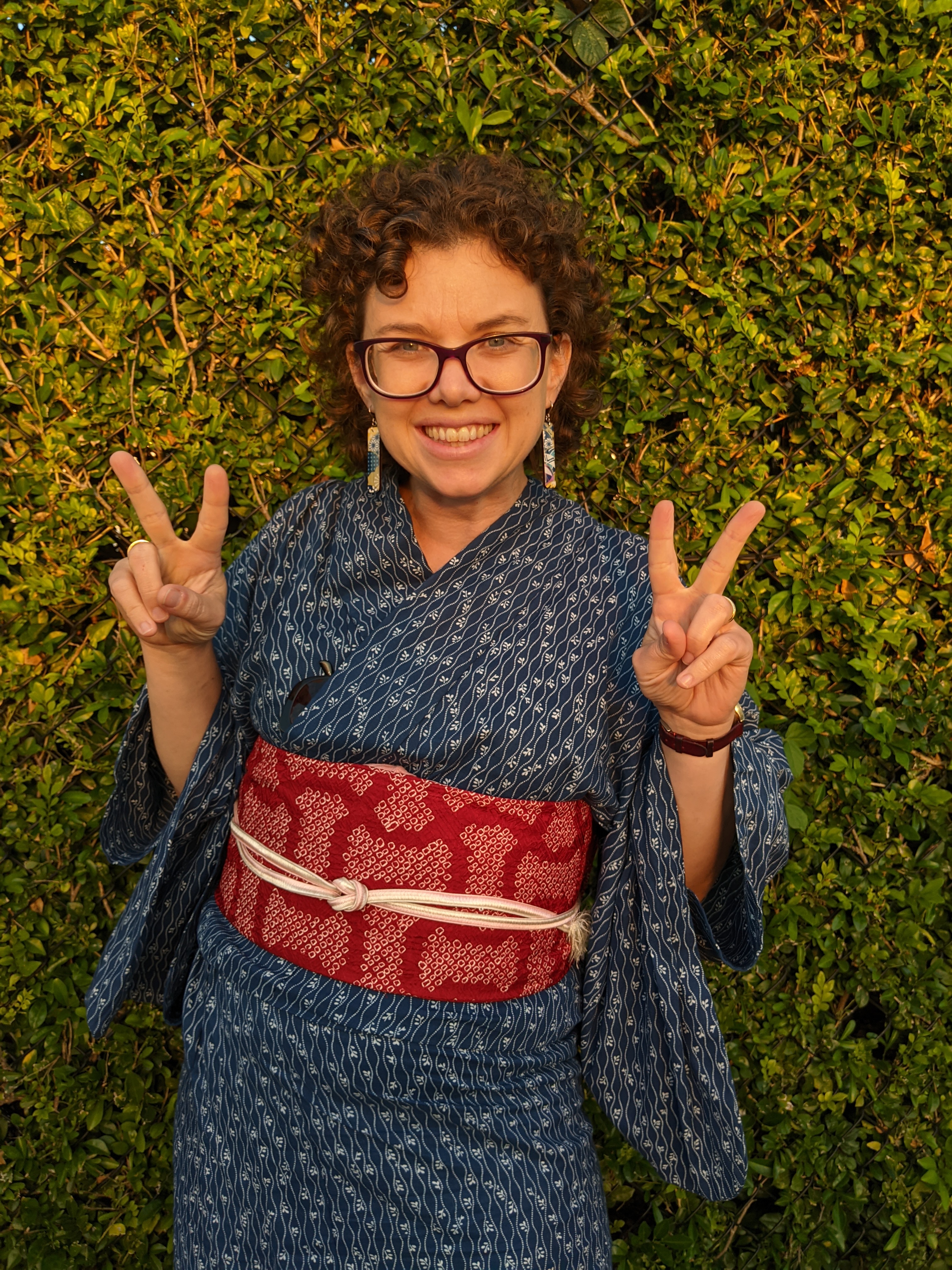
And then I wore it. With my Black Yukata and a obi that I also made. I don't know why the photos of the fabric and then the final product on look like different colours. Even looking at these ones, they come out a lot more pink looking than it is. Maybe because the obi changes things? 


I've actually worn it a bunch more because it's so beautiful and fun. It feels very fancy - especially because I know the pattern on it comes from some seriously time consuming dying techniques. 

I realised after taking these photos that I'd made this entire outfit - including the undergarments that you can't see (and I never blogged about), which is pretty wild really. 

Monday, November 24, 2025

Kimono Collection

Even though my kimono collection (here and here give pretty good snapshots if you are interested) is pretty extensive, compared both to a regular Japanese person, not to mention the average Australian, I managed to come home with a considerable of new pieces after our six months in Japan earlier this year. 

Wearing new yukata and obi for work

For those who don't know, most Japanese people would have maybe one yukata (summer cotton kimono) at home, and maybe a formal one if they had to go to a wedding (like mother of the bride type thing). But a cupboard full of them is pretty unheard of and to be honest, I think lots of people hire them for events if they need them, rather than buying them. Especially since they would likely need help dressing too. My friend Haruka doesn't even have a yukata, she thought it was hilarious that I was buying them and wearing them. 

I tried to be restrained about purchases, but since they don't just sit unworn in my cupboard, I do have some justification. I did come home with more than I expected to, but in my defence, I was gifted a number of these which I was not expecting at all. 

My "haul" stacked up and sorted, disguising just how many items there really are. 

I did take photos of each thing, but honestly, there are so many and I felt like this would get boring and long if I put all of them in. Most of the yukata that I bought while in Japan, I actually wore while we were there (or the girls did), so you've probably already seen some of this stuff anyway (here and here). And there is more than just the yukata/kimono part, there is the obi and the ties and the under stuff and what not. In the interest of not boring you - here are some highlights. 


This is possibly my favourite new yukata. I bought it with my friend Haruka at an outlet sale. It's a designer label and has an Aladdin inspired print on it. So cool. Also, the fabric weave is a specific summer one which has very subtle sections that are more see through (let me know if I'm not explaining it right, or you want more info), so that the breeze can pass through and you can stay actually cool in the hot humid summer. It really works and is so comfortable to wear. 

I did buy a large number of obi (waist belts), because they are so easy to mix and match with different kimono and wear in a variety of ways. Also, I got most of these second hand for incredibly cheap so a really great way to bring more colour and fun to the kimono wardrobe. Most of them are double sided too, so twice as much really!

Hanhaba Obi - half width

The first two obi below are the fanciest that I got and the most expensive. Still second hand and cheap compared to what they would be new. Rachel picked out the green wave one for me and I got the butterfly one from a second hand store in Matsuyama. The other two were gifted ones. 

Full width Obi (formal wear)

Along with the two obi there, I was gifted three kimono, one wool with a matching haori (jacket) and the other two beautiful silk with peach blossom patterns. One even came with matching shoes (which you can see above). I could not believe how lucky I was to be given these, especially since I was only meeting the ladies who gave them to me that day


The last thing they gave me was this absolutely stunning fuirsode (kimono with long sleeves). I actually don't own any furisode, so I was doubly excited to receive this one. It's on display in our hallway. Photos don't do it justice. The butterflies are all hand embroidered with metallic threads and metal work. 


Aside from the yukata that I bought and wore a lot, I only bought two kimono myself. One was a gorgeous green colour that was only $10 at a shop in Takamatsu. I couldn't walk past it. My final purchase was less spontaneous. I was wanting to get a black formal kimono (usually worn at weddings). Not particularly to wear, but to remake into a fancy dress. Steve and the girls gave me lots of grace as I trawled through the formal section of the second hand stores and feedback when I pulled out options. 


I eventually settled on this one with its lovely honeycomb and flowers pattern. I'm excited to sew it into a dress, and I can see the design I want to get in my mind, but I know I'll be doing a fair amount of draft and pattern work first to get it right before I cut into the actual thing. It's not like I can go out and buy more fabric if I stuff it up!

Inconceivably, I managed to pack all of the new things into the storage that I already had in our room, with only one new shelf needed. Thankfully, that shelf was only being used by Sophie's Squirrel Girl tail, which was pretty easy to relocate. The best storage solution that I have for my kimono stuff is a self made "shoe storage hanger" thing that I put together years ago now out of the leftover fabric I had from making curtains. I could have sworn I blogged about it, but I can't for the life of me find it in searches, and I've written so many blog posts now (over 950!!), trawling back through them to find it seems like a lot of work. And maybe I didn't blog about it at all? 

In any case, everything has its new home and I'm pretty happy it's here. We are eight weeks into school term now, and I've worn a yukata every day. 

Tuesday, August 05, 2025

Teacher Training Program: Japanese Culture

I've actually finished up my teacher training program (read the intro here and part two here), but I've got lots of things to remember about it, so here we go down memory lane. In between all the classes that left us feeling challenged and also exhausted (see an actual shot of us in a ten min break between lessons below), we did loads of cultural stuff. 

Some of it was just around the area we were staying, like the day we did "orienteering" in the local area, and other parts were learning about Japanese houses and etiquette for the optional homestay weekend. I really liked the focus the teachers gave on asking us to notice differences and then push ourselves to wonder why the differences exist. It was a great reminder in the world of social media videos that often complain about the differences in other cultures, or languages for likes and views that we could be different.  

After our first cultural experiences of yukata wearing and fuurin (glass wind chime) blowing, the next one we did was furoshiki. Furoshiki is a reusable cloth. The name comes from furo, meaning bath, and shiki which is like to sit. Traditionally, people would wrap up their bath things and clean clothes into the cloth and take it to the onsen to get clean. There, they would unfold their furoshiki, have their bath and when they came out, would sit on the furoshiki to finish getting dressed. 

Now days, furoshiki can be used for all sorts of things and come in a large variety of sizes and patterns. I've even made my own furoshiki before and I use them all the time in Australia. We had an intro session on furoshiki and then a hands on practical workshop to practice using them for all sorts of things. It was really great. 


We also did a shodo, or calligraphy, workshop. This was again, a very practical workshop where we learnt how to use the equipment and practice writing with the calligraphy brush and ink. I had done this before when I went to school in Japan way back in 2004, but it was great to practice again. 


After we practiced the different techniques using the kanji for eternity, we wrote a kanji of our choice on a fan to take home. I wrote frog. 


The last thing we did was a group poster with a Japanese phrase on it. We were invited to make it creative and given a number of coloured paints as well. Our group chose the Japanese saying "七転び八起き" which translates to "fall down seven times, get up eight." It's a "never give up" type of slogan. 


Pretty proud of our handiwork, though I think working together as a group was harder than actually doing the art. You think it's hard when you all come from the same place, but throw in people from five different countries with their own cultural styles a language barrier and a time limit and then you've got some work to do! 


Our art was hung in the foyer of the Japan Foundation Centre where we were in Kita Urawa, along with our classmates work. It will stay there for a year I guess, until the next summer teacher training program comes along. 

The last thing we got to do (for this post anyway) was see a shamisen performance by a world renowned shamisen player, Nobuto Yamanaka. Shamisen is a Japanese three stringed instrument which was amazing to see played so well. I could have listened for ages to all the different sounds and songs this master was performing for us. He also played shakuhachi (a wooden flute), and had a variety of shamisen for us to see. 

At the end, we got to play a little bit ourselves, so here I am playing my three notes on the shamisen. 


Finally, you might have noticed I have been wearing yukata in a few of these photos. That's because it's summer here and the right time to wear them! I wear yukata all the time back in Australia, so I figured, why not in Japan as well! I may have collected a few new ones at this point in our stay, so I just wore them when I felt like it. At first, people were shocked and confused (much like Australia), but then it was normal. 

What I wasn't expecting, was for other people to join me. A number of the ladies at my course asked me about wearing them, why and how etc. I just encouraged them to give it a go. Yukata are clothes, and there is nothing stopping you from wearing it if you want to! I was honestly so excited to have a number of the other teachers start wearing them too. Especially the teachers who said to me that they didn't think they could do it, and then were wearing them the next day. 

Didn't consider myself an influencer until now. 

Wednesday, June 11, 2025

Oyama Adventures

So my friend David, who I talked about in the Red Yukata, lived in Japan for over ten years after we graduated university. He was based in the "country town" of Oyama, in Tochigi Prefecture. It's about 2 hours out of Tokyo, though the bullet train can get you there in half that time. He was back in Japan for a month for work and various things, including a performing in a concert. 

In the lead up to the big concert event (more on that later), David had some spare time, so he asked if I wanted to do a day trip and visit. I said yes, since I was filling my days with various things just like this, and he promptly organised a whole bunch of things for us to do. 

I arrived about 11 and we went on a tour of the main sights of Oyama: namely the shrine and the remains of the castle. The street up to the shrine was beautifully lined with red lanterns and the tori gate at the entrance was suitably large. The walk around to the castle remains (I say remains, there is not much that remains...) had the view of the surrounding mountains, including, David assured me, Fuji-san in the distance, on a very clear winter day of course. 

We went from there (through a magical enchanted forest feeling park) to have sukiyaki for lunch. So good. 

I was full from this lunch for hours. I don't think I even ate dinner that day. I drank a lot more tea though. 

Then, David's friend, Shinozaki-san, picked us up from the car park and took us to her place. David had said that we were going to have tea ceremony tea there, which I had assumed was just the three of us. I was wrong. When we got there, there was a weekly group meeting of ladies who try to get together and practice English to help prevent dementia in old age. 

Then two extra ladies showed up, one who promptly off-loaded a slew of kimono and obi to David and I (eek!), and the other who actually did the tea ceremony for us. We did those things and then played a game of karuta (my first ever; it's a picture/poetry matching snap game played with 100 cards) while the "practicing English" ladies group were in the other room. Not going to lie, it was a little strange. 

Then we joined them, and had a half hour of English practising together. It was nice to meet these ladies who had adopted David into their families when he was a lonely Aussie living in Oyama those first couple of years. I did get a couple of photos of them, but I didn't ask about putting it on the internet, so I won't be sharing it here. Sorry! The tea ceremony was so lovely though, I haven't had proper tea ceremony in a really long time (can't actually remember when!). I'll likely explain what that whole thing looks like in another post. 

Then we got a lift back into town to David's rental to drop off the kimono he had acquired. Lucky him; I had to carry my five kilos of kimono around with us for the next visit and then all the way home as well. We walked to the station and stopped for a cool drink (another tea!) before we went to David's koto teacher. 

While he was living in Oyama, he learnt koto, a traditional Japanese musical instrument, generally called a harp since it's big and got strings that you pluck. Looks nothing like a traditional harp though. I've had David visit the school I teach at for the last couple of years and demonstrate koto to the students which has been fun. I've had the basics from him and can play one song, but David's teacher now gave me an official lesson. 

She had the music for Twinkle Twinkle Little Star out, (I'm a beginner, got to start somewhere!), so that's what we worked on. She played through the melody with me as I got used to it, then they tuned a third koto for David to play (the accompanying base line) as well, and she switched to the harmony line. After some more practice we stopped for a cup of cold tea (or was it juice? I've lost count) and a chat, and then practiced again. 

The koto sensei organises a big concert with all the students every two years. Not just with koto students, but also shamisen (a three stringed guitar like instrument that you play upright with a big pick) and shakuhachi (wooden recorder). They have so many students at the school, from kids to older people so it was going to be a huge concert - five hours long! I could feel how busy everyone was in the lead up and so I was very aware of the privilege it was getting to have a private hour long lesson so close to crunch time. 

After the lesson, I was back to the train station to head home. It's funny how "country" anything out of Tokyo is referred to, but the station was still surround by huge buildings, heaps of shops and things to do. I guess what makes it "country" is that ten or fifteen mins of walking away from the station, there begins to be "not much" in the way of "big city" stuff, and a car starts to be much more essential. Still. 

A week and a half later, Steve and the girls joined me on an adventure back to Oyama to attend the aforementioned concert. We did stop on the way there (bonsai!), and then I went off to the concert (it was five hours, so there was no way the girls (or Steve really) were going to last that long) while Steve and the girls had their own little Oyama adventure. 

They liked the enchanted forest, and the view from the castle ruins. Then they joined me at the concert for about three songs, before they decided to head home. I was so impressed with the concert. I've heard the koto before, but obviously mostly just David playing solo, or with me fumbling along. To hear twenty (or more!) of the instruments with different parts playing together was special. 

While I was at the concert, I did see David's tea ceremony teacher and one of the extra ladies that I'd met the week before. I fortuitously sat right in front of them in the large concert hall. Then they gave me more yukata and obi.  Eek again! The collection continues to grow. 

It was lovely to have these ladies to chat to during the breaks between songs though, since after each song, they have to reset the whole stage for the next group of performers. That means that they fully close the curtains and everyone lugs off their instruments, stands and music stands, while simultaneously a whole bunch of other people are trying to get their things onto the stage and in position for the next song. It's understandable that the concert is five hours long! Kudos to the people who made it all the way from start to finish and didn't take the easy way out like me. I guess those people don't necessarily have a two hour train trip back to Tokyo after the concert though. 

I have to say though, I did enjoy my time in Oyama, and happy that I could see and support a friend in his musical journey. Happy days! 

Wednesday, May 28, 2025

The Red Yukata

As hopefully most people know, I regularly wear (and make) kimono. Usually I use my job as an excuse (Japanese teacher!), but I often just wear them because they are beautiful. At the end of the day, they are just clothes like any other and there is no real reason not to wear them. Spoiler warning - this post is going to get into sewing in a bit of detail. 

Anyway, I didn't bring any to Japan with me (which honestly made me a little sad), but I knew I'd likely pick up at least a couple, and I was intending to get some fabric to sew them as well. I have bought more than I thought I would, and also somehow been gifted an enormous amount of them too. I'll have to take some photos of the "haul", but I may as well wait until the end of our time... just in case I accidentally get another. In all honesty, that seems unlikely, but you never know. 

My friend David who I went through uni with back in the day was in Japan for a month, and since he also sews kimono, we decided to meet up in Nippori (fabric town) and do some shopping. David also introduced me to a wholesale kimono shop owner in the back streets, that I'd never been to before. 


It was the most Japanese shopping experience since we came in, shoes off and sitting on the tatami among the fabrics. We were given cold tea to drink (it was a hot day) and there was lots of chatting before the shopping actually began. The very lovely Murata-san (Mr Murata) gave me a full run down of the fabric and how you know it's authentic etc. I did already know this, but it was beautiful to hear him talk about his craft. 

I was honestly so tempted by the designer fabrics but they were really too far out of my price range, even wholesale. Knowing I have a ton of blue yukata at home, and that I'd just bought some green ones, I was really intentional about looking for designs or colours that I didn't have, wanting to make a meaningful purchase. After much deliberation, I ended up buying two bolts of yukata cloth (yukata is summer kimono - light cotton fabric).

Then home with my prizes I went. There was no real rush to sew these, but Sophie was keen on one to match a cat obi that I had bought her. My plan is for the girls and I to wear yukata to the summer festivals (lost of people do). Given that summer was at least six weeks away, there wasn't a hugely pressing deadline, so I dallied with my cross stitch some more before I began. 

Here is the cat obi with the matching yukata fabric. Red is actually a very non-traditional yukata fabric colour. People usually wear cool colours through out summer, trying to suggest that even though it's humid and hot, they aren't uncomfortably so. This is probably why I have so many blue yukata on hand. I loved the maple leaves on this one, in their pools of water, telling the world that even though it's red, we are still going to be cool. 


I've made a stack of yukata/kimono now (I think the count is up to 8?), but I still need notes to help me remember the measurements. Alas - I had not thought to bring them to Japan with me and they were trapped in Australia! Luckily I did remember most things, one of the yukata that I'd bought was also handsewn, so I could measure parts of that for reference, and there is a somewhat helpful YouTube video by Billy Matsunaga that was also good. 

Honestly, I feel the kimono is one of the oldest forms of Zero Waste sewing that we have. The cloth is woven on a bolt that is exactly the right width and you adjust for size by having bigger or smaller seams. The fabric is cut into rectangles and there are distinct places (in the main body and sleeves) that you can hide extra fabric that could be let out later for growth or taken in. It's like magic. 

Since I didn't have my full notes on hand, I did struggle with the cutting a little, and was a little unsatisfied with the outcome. Even though I spent at least two full days mulling over, measuring, re-measuring, writing notes, drawing diagrams and measuring again! That said, the end product has nothing wrong with it; it's all that it needs to be. I did have a square and a half of fabric left, but in hindsight, I think what threw me was that the more modern bolts are made wider (35cm instead of 30) and longer to accomodate people getting taller. 

Mostly done, just the sleeves and collar to go!

Anyway, I triple checked all my pattern placement so there would be good visuals when it was done and got to sewing. Hand sewing that is. The whole thing. Don't think it took longer than a week, and I did stacks of the hemming and tacking down seam allowance while we watched the Eurovision semis and finals on YouTube. 

First fitting, wearing the obi that was closest rather than going upstairs to get the cat one.

Sophie actually loves it, so that is great. After the first fitting (pictured above) I realised I sewed the sleeves on too short to start with, so I took them off and put them on again. One of them I put on inside out, so I had to take that off and put it back on again a third time. Goodness was that a frustrating (albeit short) delay. Then I borrowed an iron from a friend to give everything a final press. 


Sophie humoured me a second time to put it on for "good" photos in the outside natural light, and Rachel decided to get in on the fun too. Can't wait to be wearing mine too as we eat kakigori (shaved ice) and watch fireworks in summer! 

Monday, September 23, 2024

Hakama Making

When we were in Japan in April, I picked up my first hakama. I gave you an introduction to it here, but it is honestly very quickly becoming a favourite addition to my kimono wardrobe. A hakama is a split side skirt (or pants) that you wear over your kimono. They honestly transform the kimono so much, from a rather slim-line dress to one that is flowy and free. 

The hakama I bought is 100% wool, so I'll be wearing it in the winter months, but I could see a light cotton one in my future to add to the spring/autumn kimono wearing. As it was, after wearing my purple hakama a few times, I was sure I could make my own. They are made from pleated rectangles of fabric with two waist ties, so very straight forward sewing. 

I did watch a handful of YouTube tutorials on hakama sewing to get a bit more of an idea about how to make them, though to be honest, what I was really after was a bit hard to find and a lot of the English tutorials were focused on cos-play versions, not authentic historical garment versions. Still good background knowledge to have. Everything else came from examining the hakama that I had on hand and trying to replicate it. 

I actually knew as soon as I decided I wanted to make one that I had the perfect fabric on hand already. From Ikea, of all places! I had bought two metres of this Japanese-looking maple print fabric a long time ago. It was so perfect for this project. I did some measuring though and found I would need at least another half a metre (for the ties), but I'd bought it so long ago it was no longer available! I did find it on the internet (Esty Canada) but paying what would work out to be $40 including shipping for a half a metre of material (that originally was $6/metre) just wasn't worth it. 

I ended up taking it to Spotlight and finding a matching plain fabric that worked for the ties. In the end, I actually think that was good anyway, since the hakama print combined with a yukata print can be a little overwhelming to look at; having the plain section in the middle to break it up is helpful. 

Deciding to just sew it on the machine, this was honestly the quickest article of Japanese clothing I've ever made. The pleats were the hardest thing, but otherwise, just so so straightforward, barely any seams (literally side seams, hem and then the ties - so minimal!) and all straight lines. If I ever need a quick palet cleanser again, this would be the garment to make!


I did about 80% of it (everything except the final sew of the ties) in a night and then left it with some heavy books on it to really help the pleats set in. It lay on the floor like that for a few days before I got around to finishing the ties. When it's all folded (in traditional origami-like Japanese style) it looks pretty dang cool. 


But even better wearing it to school. 


So hard to get a photo, so I waited until I came home and had these lovely girls help me. 


You can really see the split-side skirt nature of the hakama here. It was almost like having pockets to slide my hands into, and really, you could easily make some hidden ones to sit on the back of that front pannel with not a lot of hassle. 

I will say too, that a hakama is very "zero waste" sewing, since it was rectangles, the full width of the material, just cut to length and then sewn on to a waist band. Honestly, love this thing so much. The Ikea fabric was 100% cotton, but a heavier weight of fabric. Still, lighter than the wool one. I'd still like to make an even lighter cotton one, but for now, this is good. 

Happy days!

Sunday, July 28, 2024

Japanese Kimono Haul

I was fairly restrained in Japan when I was buying kimono related things, given that I already have quite a sizeable collection, but here are some of the things I did get! Not sure I'd really call it a haul as such, but I will say that I'm really pleased with all of what I got, since I've worn everything a number of times this year already. 

This new obi matches the yukata I made nearly 18 years ago so perfectly!

For those interested, in the winter months of the year, I tend to dress in Japanese traditional clothes most work days and then some other days just for fun too. Since I'm now working a four day week, it means I'm actually in Japanese style more than western. Have to say, I love it, since kimono are comfy, warm and surprisingly easy to layer so I can adjust things as the day heats up. 

This obi is a different style, but is so versatile that I wear it all the time. 

First up I bought three obi (waist tie/belt things). The top one was such a fun sashiko design that I was in love with it instantly, even though it was a more maroon-red colour that I wasn't sure would go with many of my yukata. It has surprisingly matched way more of my kimono collection than I thought it would and I have worn it a stack. Especially since it's reversible with a different pattern on the other side. 

This bright yellow and orange one is also so fun. Can't get enough of the dual colours and I love to mix up how I wear it too. 

Same obi as above, but looking completely different! So cool!

The light is bad, but the yukata really is more a white than yellow. This is the other side of the first obi from above. 

I also bought two yukata, a white one with sunflowers and a white with blue and purple stripes. I felt these were different to what I already have (which, to be honest, is a lot of shades of blue with flowers) so I was happy with them. 

New yukata with this obi (that I made) and a new obijime (tie).

I got one haori, which is a jacket to wear with kimono.  Again, I looked at so many of these, since they are really common in the second hand shops and the size on them can be quite forgiving, unlike a vintage kimono, which is almost always going to be on the too small size. I found this one on our day in Shinjuku and I really love it. Most of my other haori are dark, so it's nice to have a lighter choice. 

Lastly, I bought my very first hakama! This is a skirt (or pants) that you can wear with your kimono. They were worn by loads of people, notably samurai, and also used to be part of the school uniform back in the day, because it means you can run and move really easily in your kimono without and fear of things falling open when they shouldn't. This hakama took a while to find since I wanted one made out of natural fibres rather than polyester. I got a 100% wool one, which means it's pretty much only going to be worn in winter, but I love it. 

First real outing for the hakama here, with my sunflower yukata on. I'm still working on tying it at a good length, and it def looks better with boots since it's shorter. 

I was a bit disappointed when I put it on the first time, since I had been expecting it to be a bit longer and found it short, but I've made my peace with it and I have been wearing it a stack in the last few weeks at school. Since it is short, it actually looks really good with a pair of boots, so winning there. 

I did get three new obijime (obi ties), one of which I wear all the time, but the two others not so much. Still, very satisfied with the new additions to my collection. Since I've been wearing kimono pretty much non-stop for the last three months, I've also gotten my dressing time down to about 15mins for a full kimono, which is pretty dang good. I was wondering last week if it was worth it, but then on Thursday I had a stack of students tell me they loved what I was wearing or commented on a previous days dress, so I guess they are noticing after all.